
When Art Becomes Product
Has art gradually been reduced to little more than product, shaped by the constant bombardment of marketing strategies that emphasize efficiency, volume, and sales above all else? From what I observe, this shift has had a deeply negative impact on the true quality and innovation of art, much like the quiet encroachment of technology into our daily lives. The pressure to optimize, produce quickly, and remain constantly visible has subtly altered not only how art is sold, but how it is made.
Contemporary conditions increasingly force artists to work faster and more efficiently, often at the expense of exploration and risk. As a result, art begins to drift toward homogeneity. The distance between point A — the initial concept — and point B — the finished work — continues to shrink under societal and economic pressures. What once allowed time for discovery, refinement, and meaningful struggle is now compressed into abbreviated cycles of production. This silent and creeping trend threatens to erode the overall depth and vitality of what ultimately appears on gallery walls.
Such pressure often leads artists, consciously or unconsciously, to adopt techniques that are easy to execute and endlessly repeatable. Formulaic approaches emerge: puzzle-like painting process where negative spaces are simply filled with color, reducing the act of painting to a predictable process rather than an open inquiry. Colors are placed beside one another without a physical interaction on the surface, eliminating the possibility of unexpected edges, optical tension, and the accidents that so often spark true innovation. Over time, the work begins to resemble itself year after year, with few individual paintings leaving a lasting impression on the viewer or collector.
Studio time, by contrast, is precious. It is a sacred dream space — a quiet territory of reflection, intuition, and transformation. It is here that creation unfolds slowly and meaningfully, not driven by urgency but by presence and curiosity. This moment of making is both magical and deeply self-enriching, not in a dramatic sense, but in a subtle emotional elevation that nourishes both the artist and the work itself. When this space is protected, art retains its capacity for depth, authenticity, and lasting resonance.
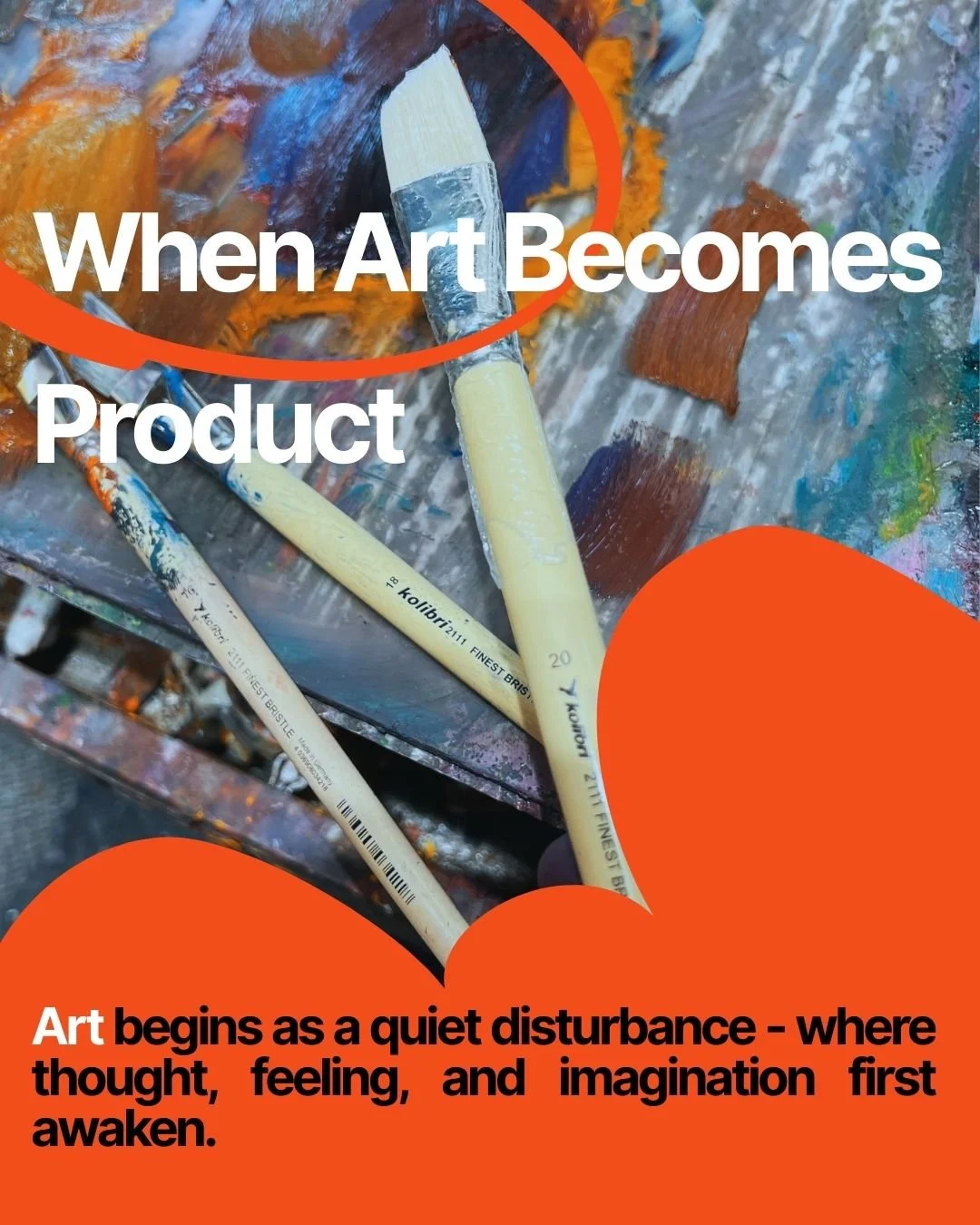
Art is increasingly portrayed as a means to financial success rather than as a deeply personal and emotional journey. In North America, with our pragmatic, results-driven approach to life, art is often reduced to a strategy for economic gain—provided one belongs to the “right” visual tribe and works within an approved context. Social media is saturated with marketing formulas promising artists success, visibility, and income, yet very little is said about what art does for the human soul, or how it can be a force for meaning, connection, and generosity in our lives.
The promise of easy financial rewards is misleading. True and lasting art rarely begins with a business plan or a motivational slogan. It begins instead as a quiet disturbance—an idea emerging from the dream space of the mind and heart. That idea must be pursued, questioned, and lived with. Along the way, it teaches through both failure and success. Some ideas are small, others expansive, but all serve as stepping stones on the artist’s path. When financial reward becomes the primary goal, art risks becoming a product, and the artist little more than a technician or merchant.
With the constant encroachment of digital technology and the culture of instant gratification, we risk losing sight of the profound beauty found in the act of creation itself—what it does to our minds, our inner lives, and our sense of purpose while we are fully immersed in it. This is what troubles me most when I see marketing campaigns or artists publicly measuring their worth by income earned or possessions acquired, followed by the familiar pitch: follow my system and you too can succeed. But what does success truly mean in the life of an artist?
There is no doubt that understanding economics and learning basic marketing skills is valuable. Artists do, eventually, have to step outside the safety of the studio and engage with the world. In that sense, practical knowledge is both necessary and empowering. What feels increasingly troubling, however, is the elevation of financial success as the only meaningful measure of artistic achievement. When that becomes the dominant narrative, it diminishes the deeper purpose of creative work and leaves a sour aftertaste.
This mindset also sets a troubling example for younger artists just beginning their journeys. The true spirit of creation is quietly eroded by the pursuit of social validation, manufactured moments, and short-term rewards. Yet meaningful art demands time, patience, focus, and an uninterrupted devotion to the process. When creation turns into a race, the subtle nuances—the moments of discovery, vulnerability, and growth—are easily lost, trampled beneath the weight of unrealistic expectations.
Art, at its core, is not about arriving quickly or winning visibly. It is about becoming—slowly, honestly, and deeply—through the act of making.
Under the weight of commercial pressure and gallery expectations, artists are often pushed to produce work at an accelerated pace—filling walls, meeting quotas, and maintaining the appearance of abundance. In these conditions, something essential is frequently lost. The time required for deeper exploration, complex composition, and technical refinement is traded for speed and familiarity. Work becomes simplified, guided more by surface appeal and predictable subject matter than by intent or discovery.
Meaningful, timeless, and truly distinctive art rarely emerges from haste. It requires space—time to think, to experiment, to fail, and to return with clarity. Slowing down is not resistance to the market; it is a commitment to integrity, depth, and lasting value.